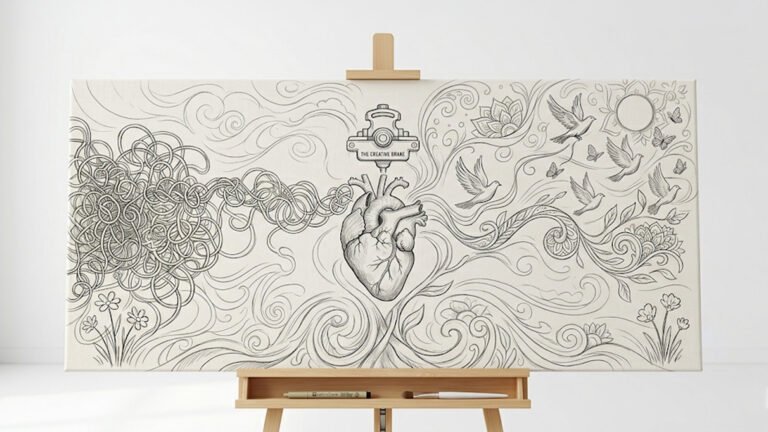
The Creative Brake: How Art Therapy Releases Stored Tension from Our Bodies and Our Relationships
There is a particular kind of exhaustion that has nothing to do with how many hours you slept. You wake up already tense. By mid-morning, a colleague’s offhand comment lands harder than it should. By evening, a two-word text from someone you love reads as an accusation. You snap. They withdraw. And somewhere in the back of your mind, a quiet voice asks: why does everything feel like a fight lately?
The answer, more often than we realize, is not in our heads. It is in our bodies.
When the World Gets Under Our Skin
Modern life stress is not dramatic in the way we expect it to be. It rarely announces itself. Instead, it operates through little clashes the micro-frictions of daily life that accumulate without resolution. A delayed reply. A misread tone. A conversation that ended wrong. A commute in traffic. A deadline that shifted. None of these is catastrophic in isolation. Stacked together, across days and weeks, they become something else entirely.
Deceptively, these frictions don’t pass through us and disappear. They settle. Stress, in physiological terms, is not just a feeling it is a chemical event. Cortisol, the body’s primary stress hormone, floods the system when we perceive threat. In moments of genuine danger, this is adaptive. The body mobilizes, responds, recovers. But when the source of threat is ambient and unrelenting , then we are never fully safe, never fully done, never fully at rest. cortisol doesn’t flush out. It accumulates. It takes up residence in the muscles, in the jaw, in the shoulders, in the gut.
And a body saturated with cortisol is a body on hair-trigger alert. In this state, the nervous system is not distinguishing between a genuine emergency and an ambiguous text message. It responds to both the same way: with the full machinery of defense. This is not a character flaw. It is biology. But it is also why, when our bodies are flooded with unprocessed tension, even the most ordinary interaction with someone we love can detonate into misunderstanding.
The question is not how to eliminate stress from a world that is, by nature, stressful. The question is whether there is a way to process what our bodies absorb before it comes out sideways in our relationships.
The Body Doesn’t Lie
Cathy Malchiodi has spent decades studying the intersection of creative expression and the nervous system. Her central conviction, repeated across her work, is unambiguous: the body does not lie.
What she means is this. Long before a feeling becomes a thought before it is named, analyzed, or communicated it lives in the body as sensation. Tightness. Restlessness. The impulse to move or the inability to. When we try to process emotional experience through language alone, we are working with only part of the signal. The body, meanwhile, is still holding the rest.
Art therapy engages the nervous system through a different channel. When the hands are moving, mixing color, pressing clay, drawing without a “destination”, something shifts in the body that talking about the experience does not produce. The sensory engagement of making something activates the parasympathetic nervous system: the branch responsible for rest, digestion, and repair. Cortisol levels begin to fall. Breathing slows. Muscle tension releases. The body transitions, gradually, from the fight-or-flight posture it has been holding, into something closer to equilibrium. Sometimes that tension is held for months or even years.
This is not mysticism. It is measurable. Multiple studies have documented significant drops in cortisol following art-making sessions, even brief ones. The medium matters less than the engagement. What matters is that the nervous system is given an experience that signals: you are not in danger. You can let go now.
The word Malchiodi returns to is regulation. Not suppression. The difference is significant. Suppression pushes the body’s signals down, compresses them, delays their expression but doesn’t resolve it. Regulation processes them through. It restores the nervous system to baseline, so that the next encounter with the world the next difficult conversation, the next unexpected setback is met from a place of relative calm rather than accumulated alarm.
Slowing Down Time
Shaun McNiff approaches this from a different angle, but arrives at the same place.
In Art Heals, McNiff describes what happens when a person genuinely enters the creative process: time changes. Not metaphorically, but experientially. The relentless forward momentum of worry, planning, replaying, anticipating the mental noise that constitutes most of our waking hours quiets. The mind, occupied with the immediate and the sensory, stops running ahead of itself.
McNiff calls this becoming grounded. The word is precise. When we are ungrounded, we are living in the imagined future (the worst-case scenario we keep rehearsing) or the unresolved past (the conversation we can’t stop replaying). We are, in the most literal sense, not here. The body is present but the self is elsewhere, circling through anxieties that exist nowhere except in the mind’s restless projection.
Making something, even something small, or even something terrible by conventional aesthetic standards pulls us back into the present through the body. The texture of the paper. The resistance of the brush. The decision about whether this mark should go here or there. These are now problems. They cannot be solved in advance or avoided in retrospect. They exist only in this moment, and attending to them requires being here.
This return to the present is not a technique for ignoring problems. It is a necessary precondition for dealing with them well. A mind that is perpetually accelerating, perpetually reactive, perpetually somewhere other than where it actually is. In such fashion, a mind is not capable of its best thinking. Slowing down is not retreat. It is the beginning of clarity.
The Rhythm in Relationships
Here is where the personal becomes relational.
When our bodies are dysregulated, when cortisol is high, and when the nervous system is in a state of chronic alert, our capacity for accurate perception narrows. We read neutral expressions as hostile. We interpret ambiguity as criticism. We respond to complexity with the blunt instruments of defensiveness or withdrawal, because the sophisticated social cognition that allows for patience, nuance, and generosity requires neurological resources that stress actively depletes.
In practical terms: a dysregulated nervous system doesn’t just make us feel bad. It makes us worse at being with other people. It makes us more reactive, less empathic, more likely to respond to the person we love from a posture of self-protection rather than genuine contact.
The opposite is also true. When the nervous system is regulated, when the body has been given the opportunity to process what it has been holding, perception clears. A tone of voice is just a tone of voice. A silence is just a silence. The other person is no longer filtered through a lens of accumulated threat; they are simply themselves again, complicated and human and worth engaging with carefully.
This is the arc that art therapy, practiced consistently, can support. It does not begin in the relationship. It begins in the body. The relationship between a person and their own interior life, and between the self and the unprocessed experience, is repaired first. And from that repair, the quality of presence that makes real connection possible becomes available again.
This is not a dramatic transformation. It is a quiet one. It looks like having enough space inside yourself to pause before responding. It looks like hearing what someone is actually saying rather than what your nervous system is primed to hear. It looks like being capable of curiosity instead of defensiveness, of stillness instead of reflex.
What We Can Actually Control
We cannot quiet the world. The friction will continue the pressures, the pace, the accumulated weight of living in a time that demands constant navigation. This is not a problem that personal practice can solve at a structural level, and pretending otherwise would be dishonest.
But there is something we can control. We can choose what we do with what the world deposits in our bodies. We can decide whether the cortisol accumulates unchecked or finds a channel through which it can be discharged. We can give our nervous systems the regular experience of coming down from alert.
Art, in this sense, is not decoration. It is not a hobby for those with leisure time. It is one of the oldest and most reliable technologies for returning the body to itself for converting the residue of stress into something that can be released, expressed, and transformed.
The ten minutes of drawing that asks nothing of you. The movement of hands that has no goal beyond the movement itself. The mark on paper that no one will ever judge.
These are not escapes from life. They are the conditions under which it becomes possible to live it fully, be present, and make mindful choices consistently.
Drawing on the work of Cathy Malchiodi and Shaun McNiff in Art Heals: How Creativity Cures the Soul (2004)