Escaping the Prison of “Standards” How to Find Space for Ourselves in a Noisy World
We all live inside a strange paradox. On one hand, the world feels chaotic and relentlessly fast every day a flood of news, messages, and expectations crashing in from every direction. On the other hand, the more chaotic things get, the greater the pressure to be excellent. We must be model employees, flawless parents, keep tidy homes, and even our leisure time must conform to standards set by others. And when we finally run out of breath in this endless sprint, we can’t find a place for our feelings because we were never taught to make room for them.
This constant pressure to meet every standard slowly steals our capacity to taste life as it actually is. Not all at once. Not in any way we’d notice. Quietly, like water leaking from a cracked pipe.
A Suitcase That Never Gets Opened
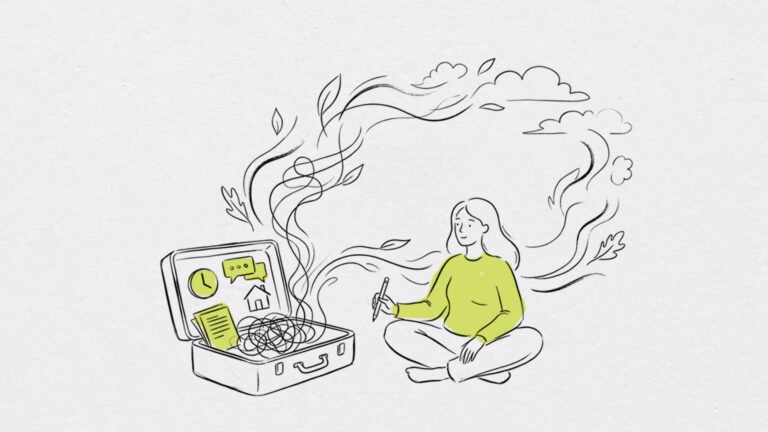
Imagine spending all day packing things into a suitcase. Everything you experience throughout the day, every stressor, every joy, every unspoken worry gets pushed inside it. But you never get the chance to open it. The next morning you do the same thing, adding a fresh layer over everything from the day before. Our minds work exactly this way. We constantly accumulate things inside ourselves without ever making time to unpack them.
Unpacking means this: opening that suitcase. Not necessarily to organize it, not to do something with everything you find, but simply to see what’s inside. To be present with it. To let it exist.
This is the part that tends to get forgotten. We look for solutions to every problem. But what our feelings often need isn’t a solution it’s space. Space where they can breathe.
Art as Medicine of the Interior
Shaun McNiff, art therapist and university professor, spent more than three decades with a single question: why does art heal? His starting point was perhaps the most ordinary imaginable. The year was 1970, a psychiatric hospital in Massachusetts, a room converted into a studio, and patients no one expected to create anything of significance. But something happened in that room that occupied McNiff for the rest of his life.
In Art Heals, McNiff writes that art is a medicine the soul uses to treat itself. But this sentence deserves careful reading. He uses “medicine” as a metaphor for something that acts upon the soul, not something that eliminates the problem. It resembles the distinction he draws between curing and healing: one can find healing even when no cure exists.
The most important point McNiff insists on, however, is this: art therapy is not only for artists. It is for human beings. Many of us are frightened by the word “art” because we immediately assume we must be painters, must draw well, must produce something fit for display. But that fear is itself part of the prison of standards: the same inner voice that says: if you can’t do it well, don’t do it at all.
In art therapy, what matters is not the result but the process. McNiff argues that when we begin making something; even if it’s nothing more than scribbling, or playing with color. the part of our mind that is constantly monitoring and judging goes quiet. And that moment of silence, that brief pause of the inner critic, is part of the mechanism of healing.
A Language for What Goes Unsaid
Cathy Malchiodi, one of the most important practitioners in art therapy, approaches this idea from another angle. Words are sometimes inadequate, not because they are false, but because some things are simply not made of language.
When you are tired but don’t know why. When you are sad but can’t identify the reason. When you feel a heaviness you can’t put into words. A swift stroke of a brush across paper, or the instinctive reach for a dark color, might reflect your state more honestly than a thousand words ever could. Art is a language for expressing the unspeakable things that have no place in our rational, well-organized world.
This resonates especially deeply for those who grew up in cultures where emotional expression was never modeled. In many cultures our own included talking about feelings is not a skill that gets taught. We learn to endure, to carry on, to be patient. But we never learn how to see what’s actually living inside us. Art can offer precisely this: a way of looking inward without needing to explain what we find.
Where Is This Space?
Here is where a common misunderstanding needs to be corrected. When we speak of an “art therapy space,” the image that typically forms is a well-equipped room with shelves of paint and paper and a trained therapist on hand. But that is not the only possible form. McNiff is emphatic that art can heal in any environment where the conditions for creative freedom exist.
The gym where you put your phone away and are simply present in your body, that can be the space. The family dinner table where you speak without judgment. The solitary morning walk with no destination other than the walking itself. All of these can fulfill the role of that room. What matters is that in that space, no one expects you to be your best not even you.
McNiff calls this “liberating creativity” and believes this freedom is inherently healing. Because the root of our difficulty is often not grief or anxiety in themselves, but their persistent suppression. Art in any form is a way of breaking that suppression, not through force, but by simply allowing things to exist.
The Freedoom of Calm
What is beautiful about this picture is a kind of freedom. Peace, healing, and inner space are not privileges available only to those who can afford a studio or a therapy session. Anyone can build their own “space without standards.” It doesn’t matter where you live, how much free time you have, or whether you feel any connection to “art” as a concept.
Perhaps the most important thing McNiff teaches us is this: you don’t need to be an artist to benefit from art. You don’t need to be ill to find healing. You don’t need to attend a class, follow instructions, or produce anything for display. You only need to create a space where, for a little while, you simply are.
Reclaiming the Right to Simply Be
The modern world quietly turns us into machines that execute tasks. Machines with various capabilities, precise schedules, and clear performance metrics. In this world, being without productivity looks like laziness. Feeling without resolution looks like a waste of time.
But we are human. And being human means having an interior world that is not always logical, not always efficient, not always explicable. That interior world needs attention not so we can become better, but so we can remain alive.
Having a personal space for unpacking experience is not a luxury. It is a necessity. Like sleep. Like water. Not in the sense that we’ll die without it, but in the sense that without it, something is gradually taken from us, and eventually we can no longer even remember its name.
A simple invitation: today, for just ten minutes, do something for which there is no metric of success. Not to improve yourself. Not to produce a result. Only to be.
That, perhaps, is the simplest form of healing.
Drawing on the ideas of Shaun McNiff in Art Heals: How Creativity Cures the Soul (2004)