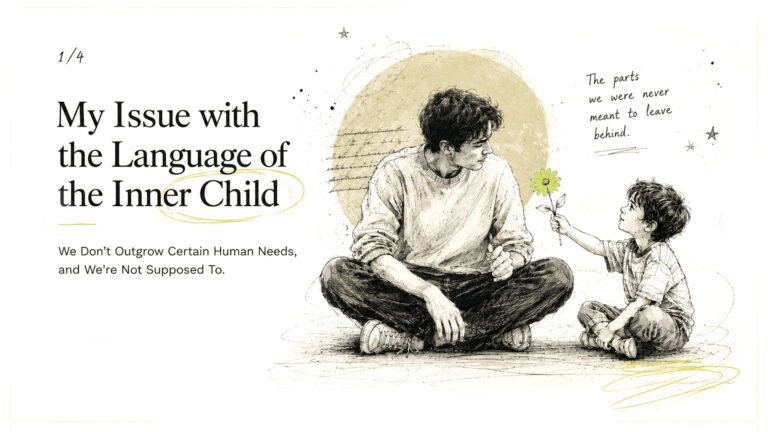
My Issue with the Language of the Inner Child
We Don’t Outgrow Certain Human Needs, and We’re Not Supposed To
The Trend That Inspired Me to Write This
The term inner child has become deeply embedded in the language of modern therapy, self-help, and online psychology. It’s often used to describe the vulnerable, emotional, wounded, playful, or neglected parts of ourselves, the parts that carry unmet needs, unresolved pain, fear of abandonment, longing for safety, or the desire to simply be seen and cared for.
But over time, I’ve developed a growing discomfort with the term itself and the assumptions hidden inside it. Because whether intentionally or not, the language of the inner child seems to imply that certain emotional needs fundamentally belong to childhood, that they are things we are meant to outgrow, mature beyond, or only revisit when something has gone wrong.
And I think this becomes even more complicated when this language enters cultures already built around hyper-independence, emotional suppression, relentless productivity, or performance-based worth. I’m not trying to defend or attack any of those cultures here, at least not in this post haha, but I do think that placing vulnerability, dependency, play, or emotional longing under the category of “the child” can unintentionally reinforce the idea that these experiences are somehow less adult, less evolved, or less legitimate.
And I’m no longer convinced that framing human vulnerability this way is accurate, or even helpful.
The Myth of the Finished Adult
I also think the pace of modern life makes it difficult for people to slow down enough to question the philosophy underneath all of this. We move quickly, optimize quickly, produce quickly, and constantly pressure ourselves toward clearer outcomes, cleaner identities, and more polished versions of ourselves.
But I’ll say this honestly: completeness is often a myth when it comes to the deepest and most important parts of life.
Relationships are not complete. Creativity is not complete. Identity is not complete. Grief is not complete. Healing is not complete. Even self-understanding is not complete.
And I think something unfortunate happens when we become overly obsessed with completion, optimization, or finality in areas that are fundamentally alive and evolving. We begin sacrificing process for outcome, experience for performance, openness for certainty, generativeness for control.
We start relating to life like a finished product instead of a living process.
Some things absolutely require completion: a tax file, a report, a contract, a work shift. But many meaningful human experiences lose something essential the moment we try to force them into permanent closure or polished perfection.
Because living things move.
Living things change.
Living things remain open.
So, What Am I Actually Suggesting?
Go do something you’re unfamiliar with.
Go somewhere where you feel slightly stupid again. Be a beginner. Try something you’re not naturally good at. Enter spaces where you don’t fully know the rules yet.
Go make something awkward.
Go be lost for a while.
Go feel clueless.
Go experience uncertainty without immediately rushing to turn it into mastery.
Do something you once dismissed as pointless, pretentious, childish, fake, or beneath you, and stay curious long enough to see whether there is actually something alive inside it.
Because a lot of meaningful transformation does not come from remaining emotionally defended and permanently composed.
It comes from openness.
From experimentation.
From vulnerability.
From allowing yourself to be changed by experiences you could not fully predict beforehand.
And honestly, many breakthroughs, creative, emotional, relational, even existential ones, begin the moment a person becomes willing to stop protecting themselves from feeling incomplete.
So maybe what we often call the “inner child” is not childishness at all.
Maybe it is the curious part.
The creative drive.
The experimental part.
The emotionally open part.
The part still capable of wonder, movement, vulnerability, and transformation.
Maybe the goal is not completion.
Maybe the goal is allowing enough incompleteness for movement and circulation to remain possible.
Living things move.
Living things change.
Living things remain open.