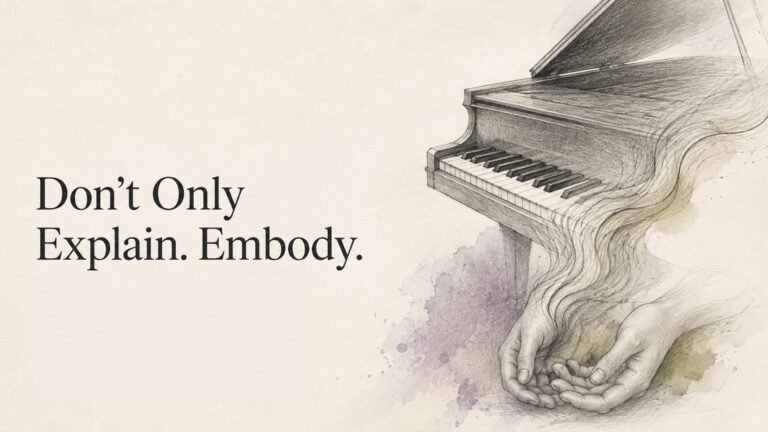
One of my music teachers steadfastly insisted that I separate the individual lines within a musical texture. Rather than repeatedly playing the entire passage and hoping it would eventually come together, I had to take each line on its own.
And I could not merely play the correct notes. I had to play each line musically. I had to attend to its shape, movement, tension, and direction. Sometimes I would sing the line before playing it. Sometimes I would clap its rhythm, removing the notes altogether so I could feel its pulse. I might slow it down, repeat a small gesture, or listen carefully to how one phrase leaned into the next.
At first, this could feel unnecessarily slow. The passage already existed on the page. I could see how its parts fit together. Why not simply play it?
But seeing the structure was not the same as knowing it. Each line had to enter the voice, the hands, and the ear. The rhythm had to become physical. The phrase had to be isolated, attended to, felt, and absorbed. Then, when the lines were brought back together, something would click. What had previously felt crowded or mechanical began to move as one living texture.
Psychotherapy Can Work in the Same Way
Psychotherapy can work in a similar way.
People often bring emotional difficulties into therapy hoping for a recipe: a set of steps that will explain the problem and tell them how to solve it. The wish is understandable. When something hurts, we want to know what to do.
But emotional life rarely yields to instruction alone.
It is not enough to talk about the feeling from a distance. At some point, we have to let it enter the room. You have to feel it and help me feel it with you. Not so that we become overwhelmed by it, but so that we can attend to its texture together: where it gathers in the body, what makes it intensify, what causes you to retreat, which words become difficult to say, and what changes when another person remains present.
Much of psychotherapy happens within these subtleties. We move through experience moment by moment, slowing it down as my teacher slowed down a musical passage. We isolate one line: a tightening in the chest, an interrupted breath, an impulse to appease, or a flash of anger. We listen to it, give it room, and make small adjustments.
Small Shifts Change the Whole Composition
Perhaps the breath deepens slightly. Perhaps the person stays with the feeling for two seconds longer. Perhaps they discover that they can say no without abandoning the relationship, or feel grief without being swallowed by it.
These changes may seem modest, but they build space around the emotion. The feeling is still there, yet it no longer occupies the entire composition. Other lines become audible: curiosity, choice, self-protection, tenderness, and even play.
Therapy does not simply give us a better explanation of the music. It helps us hear it, feel it, and gradually learn how to play it differently.